


Thailand is entering a new phase of investment promotion policy. Under the latest direction introduced by the Thailand Board of Investment (“BOI”), foreign manufacturers seeking enhanced tax incentives will no longer be evaluated solely on production capacity or export potential. Instead, the government is increasingly focusing on whether multinational groups are prepared to relocate strategic business functions into Thailand alongside their manufacturing operations.
The policy shift reflects Thailand’s broader ambition to position itself as a regional operational hub amid the continuing global restructuring of supply chains. As geopolitical tensions, trade fragmentation, and “China Plus One” strategies accelerate across Asia, the Thai government is attempting to capture not only industrial investment, but also regional management authority, technical expertise, and high-value business activities.
Under the new 2026–2027 comprehensive relocation framework, foreign investors may qualify for an additional three to five years of Corporate Income Tax (“CIT”) exemption if manufacturing projects are accompanied by the establishment of an International Business Center (“IBC”), regional headquarters, or R&D and engineering functions within Thailand.
This represents a significant departure from Thailand’s previous incentive model. The government is no longer satisfied with attracting factories alone. It increasingly expects companies to embed long-term operational substance within the country.
The Shift from Production Base to Regional Command Center

For many years, Thailand’s investment promotion regime successfully attracted manufacturers through tax holidays, import duty exemptions, and industrial infrastructure support. However, a substantial portion of these projects operated under relatively limited local structures, where key commercial decisions, procurement authority, intellectual property ownership, and regional strategy remained outside Thailand.
The new relocation mandate appears designed to change this dynamic.
Rather than functioning merely as an export production platform, Thailand is positioning itself as a regional command center for multinational supply chains. The BOI is now encouraging companies to centralize regional procurement operations, technical support services, engineering management, treasury coordination, and cross-border business administration within Thailand itself.
From a policy perspective, this approach serves several strategic objectives. It strengthens the domestic economy by increasing demand for skilled labor and professional services, deepens integration between foreign investors and local industries, and reduces the risk of mobile “temporary” manufacturing investments that can easily relocate to lower-cost jurisdictions.
More importantly, it aligns Thailand with the broader global trend toward economic substance-based regulation.
Economic Substance Is Becoming the Central Regulatory Principle
One of the most important aspects of the new framework is that enhanced incentives are increasingly linked to demonstrable operational substance rather than formal corporate structuring alone.
This reflects the growing influence of international tax and regulatory developments, including OECD BEPS initiatives, global minimum tax enforcement, transfer pricing scrutiny, and anti-base erosion measures implemented across major jurisdictions.
In practical terms, authorities are likely to place greater emphasis on whether strategic functions are genuinely performed in Thailand. Companies claiming IBC or regional headquarters status may need to demonstrate that senior management personnel located in Thailand possess real operational authority over procurement activities, regional coordination, budgeting, and commercial decision-making.
Similarly, businesses seeking enhanced relocation incentives may face closer examination regarding the transfer of technical capabilities, engineering functions, supply chain management systems, and regional support services into the Thai entity.
This creates important implications for multinational groups that historically maintained low-profit manufacturing entities in Thailand while retaining higher-value commercial functions offshore. As Thailand increasingly positions itself as a regional operational center, regulators may expect profit allocation, transfer pricing structures, and business substance to align more closely with the functions actually performed within the country.
The direction of policy suggests that purely administrative or “paper-based” relocation structures will face increasing difficulty under future regulatory review.
Why the International Business Center Structure Has Regained Strategic Importance
The International Business Center regime is expected to become significantly more relevant under the new relocation landscape.
Previously, many foreign investors viewed the IBC framework as secondary compared to manufacturing promotion privileges. However, the current policy environment is changing that perception. By combining manufacturing operations with regional management or technical functions, companies are able to present a more integrated operational model that aligns with the BOI’s long-term economic objectives.
A properly structured IBC can support regional management services, procurement coordination, treasury functions, technical assistance, and supply chain oversight across ASEAN markets. More importantly, it allows multinational groups to establish Thailand not only as a production location, but also as the central coordination point for regional business activities.
This distinction may become increasingly valuable as competition among ASEAN jurisdictions intensifies.
Thailand’s geographic position, developed industrial infrastructure, expanding electronics and EV sectors, and relatively balanced geopolitical position provide meaningful advantages for companies seeking long-term regional stability. The BOI appears determined to leverage these advantages by encouraging deeper operational migration into the country rather than limited manufacturing investment alone.
Regulatory Oversight and Compliance Risks Will Intensify
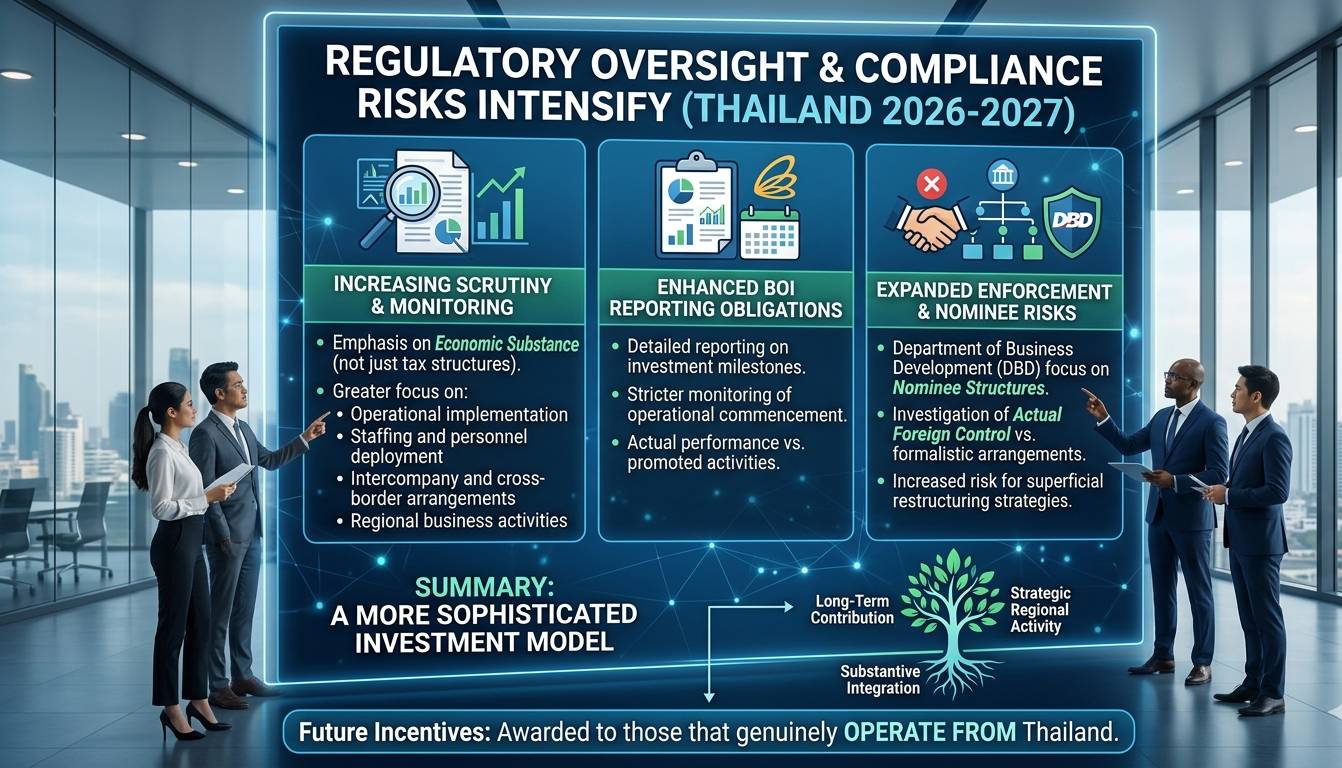
While the comprehensive relocation framework creates substantial opportunities for foreign investors, it also signals a stricter enforcement environment.
Thai regulators are becoming increasingly focused on identifying structures that seek to obtain tax incentives without corresponding economic substance. As a result, promoted companies should expect greater scrutiny over operational implementation, staffing structures, intercompany arrangements, and regional business activities.
Enhanced BOI monitoring obligations are likely to play an important role in this process. Companies receiving extended tax privileges may face more detailed reporting requirements regarding investment milestones, operational commencement, personnel deployment, and the actual performance of promoted activities.
At the same time, broader enforcement initiatives by the Department of Business Development (“DBD”) concerning nominee structures and actual foreign control may intersect with BOI-promoted projects. Businesses relying on formalistic ownership arrangements without genuine operational integration into Thailand may encounter increased regulatory attention in the coming years.
The overall policy direction indicates that Thailand is moving toward a more sophisticated investment promotion model — one that prioritizes long-term economic contribution, strategic integration, and substantive regional activity over purely transactional investment structures.
Thailand’s 2026–2027 comprehensive relocation mandate represents more than a temporary investment incentive program. It reflects a broader transformation in the country’s economic strategy and its position within the evolving global supply chain environment.
The BOI is no longer competing solely for factories or export volume. It is competing for regional headquarters functions, technical expertise, supply chain control, and long-term operational integration.
For multinational groups, this creates both opportunity and complexity. Companies prepared to relocate meaningful management, engineering, and regional business functions into Thailand may secure significant tax advantages and strategic positioning within ASEAN. However, businesses pursuing superficial restructuring strategies without genuine substance may face increasing regulatory scrutiny from multiple authorities.
Ultimately, the new framework signals a clear policy message from Thailand: future incentives will be awarded not only to companies that manufacture in Thailand, but increasingly to those that genuinely operate from Thailand.
