


Thailand’s Board of Investment (“BOI”) has introduced a significant change to its post-approval compliance framework under Board Announcement No. 8/2569. The previous bi-annual project progress reporting system has now been replaced with mandatory quarterly submissions through the BOI e-Monitoring platform.
While the revised procedure may initially appear to be an administrative adjustment, the enforcement mechanism behind it reflects a much stricter regulatory approach. Under the new framework, promoted companies that fail to submit reports for two consecutive quarters may face automatic suspension of BOI privileges, with potential permanent revocation of the promotion certificate within approximately six months.
For BOI-promoted businesses, particularly foreign-invested companies operating in Thailand under investment promotion privileges, the implications are substantial.
A Shift Toward Continuous Regulatory Oversight
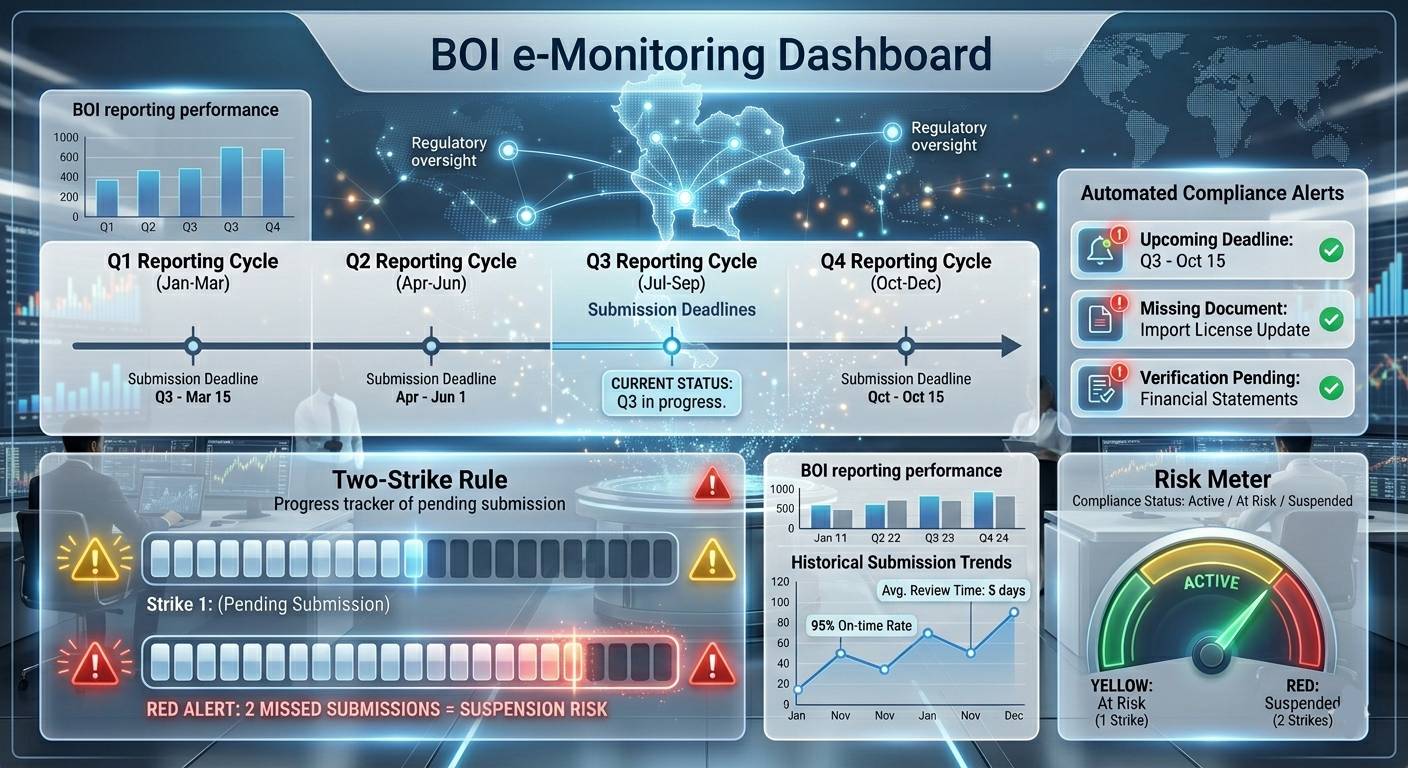
The transition from semi-annual reporting to quarterly e-Monitoring demonstrates the BOI’s broader move toward continuous compliance supervision. Rather than relying on periodic updates, the authorities now seek to monitor project implementation more closely and identify inactive or delayed investment projects at a much earlier stage.
This reflects a wider trend in Thailand’s regulatory environment, where digital monitoring and post-approval enforcement are becoming increasingly important. BOI promotion is no longer viewed solely as an approval process granting incentives and privileges; it has evolved into an ongoing compliance obligation requiring consistent regulatory engagement.
For many companies, particularly those in construction phases, pre-operational stages, or undergoing internal restructuring, the shortened reporting cycle may create additional compliance pressure. Administrative oversight, delayed documentation, or internal communication gaps may now carry considerably greater legal and operational consequences than before.
The “Two-Strike” Rule and Its Business Impact
The most critical aspect of the new framework is the enforcement mechanism commonly referred to as the “Two-Strike” Rule.
Under the revised policy, failure to submit quarterly e-Monitoring reports for two consecutive periods may trigger the immediate suspension of BOI privileges. Depending on the circumstances, continued non-compliance may subsequently lead to permanent revocation of the promotion certificate within a relatively short timeframe.
The consequences extend far beyond administrative penalties. Suspension of BOI status may directly affect a company’s ability to utilize corporate income tax incentives, import duty exemptions, machinery import privileges, and visa or work permit facilitation for foreign employees.
For foreign-majority companies that rely on BOI promotion to support business operations otherwise restricted under Thai foreign ownership regulations, the risks may become even more significant. In certain cases, loss of BOI privileges could potentially impact the broader regulatory structure under which the business operates.
This development signals that the BOI is adopting a far more active enforcement position compared to previous years, where companies often had greater flexibility in resolving delayed reporting matters.
Why Internal Compliance Systems Have Become Essential
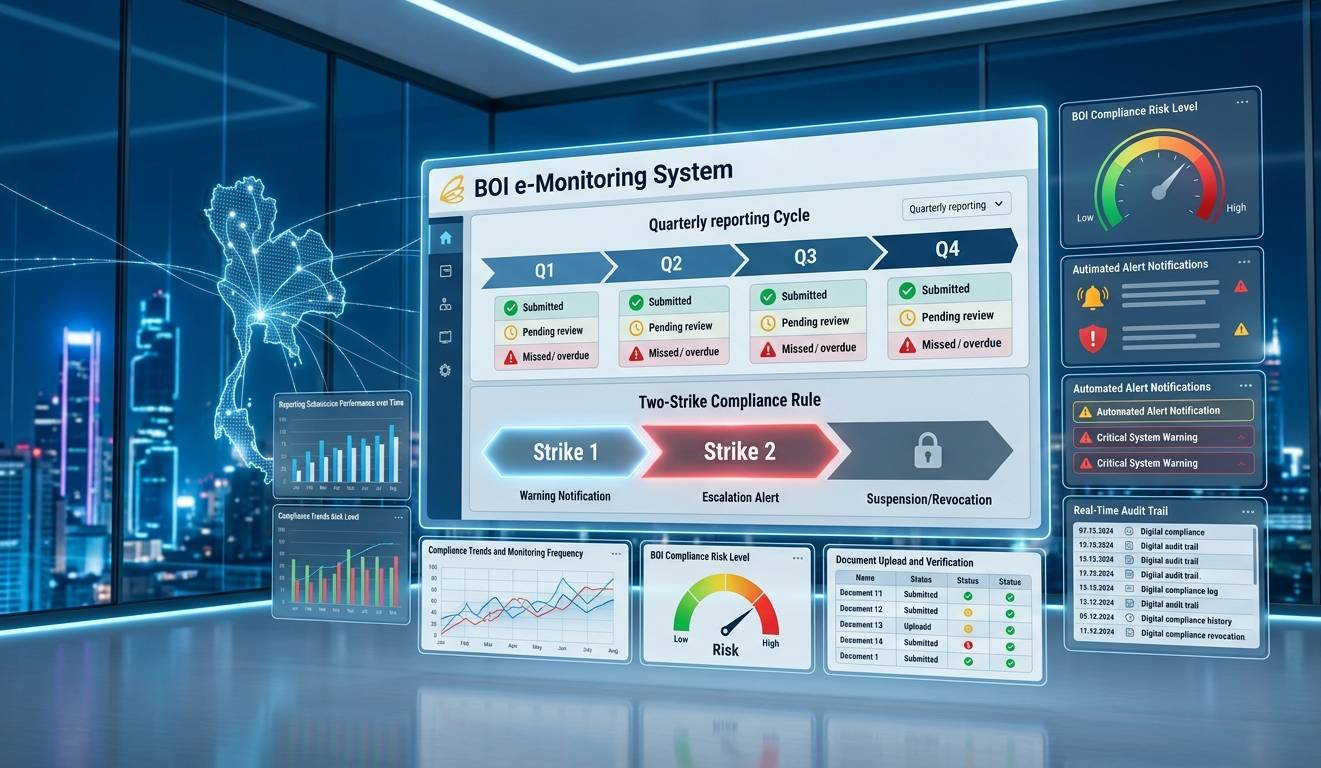
The new quarterly monitoring regime highlights the growing importance of internal compliance management for BOI-promoted companies.
Many businesses remain operationally compliant in substance but still face exposure due to missed filing deadlines, incomplete submissions, or insufficient coordination between departments. Under the current framework, even temporary administrative failures may escalate into serious regulatory issues if not addressed promptly.
As a result, companies should consider implementing more structured compliance procedures, including internal reporting schedules, centralized document management, and regular reviews of project implementation status. Coordination between legal, accounting, HR, and operational teams is becoming increasingly necessary to ensure that BOI obligations are fulfilled accurately and on time.
This is particularly important for multinational groups and foreign investors managing multiple entities or regional operations in Thailand, where BOI promotion often forms a critical component of the overall investment structure.
A New Compliance Era for BOI-Promoted Businesses
Board Announcement No. 8/2569 reflects a broader transformation in Thailand’s investment promotion landscape. The BOI is moving toward a more data-driven and enforcement-oriented regulatory model in which ongoing compliance is monitored more actively than ever before.
For investors and promoted companies, the key challenge is no longer limited to obtaining BOI approval. Maintaining compliance after approval has now become equally critical.
Businesses that continue to treat BOI reporting obligations as routine administrative formalities may underestimate the seriousness of the new quarterly e-Monitoring regime and the risks associated with the “Two-Strike” enforcement framework. In the current regulatory environment, proactive compliance management is rapidly becoming an essential part of protecting both BOI privileges and long-term business operations in Thailand.
