


Thailand’s foreign investment landscape is entering one of its most significant regulatory shifts in recent years. Effective from 1 April 2026, the Department of Business Development (“DBD”) officially implemented DBD Order No. 1/2569, introducing stricter scrutiny over company ownership structures involving foreign participation.
The new enforcement approach focuses not only on who appears as shareholders on paper, but also on who truly exercises control over the business. As a result, traditional ownership structures that once relied on Thai nominee shareholders are now facing unprecedented regulatory attention.
For many foreign investors operating in Thailand, this development represents a major turning point. More importantly, it is rapidly increasing the importance of Board of Investment (“BOI”) promotion as the most secure and legally sustainable route for maintaining foreign ownership and operational control in Thailand.
Thailand’s Shift From “Shareholding Percentage” to “Actual Control”
Under Thailand’s Foreign Business Act B.E. 2542 (1999) (“FBA”), certain business activities remain restricted to foreign-owned companies unless special approval or exemptions are obtained.
Historically, many foreign investors structured their businesses using the familiar “51/49” model, where Thai nationals formally held majority shares while foreign investors retained practical control through financing arrangements, voting rights, management authority, or private agreements.
Although nominee shareholding arrangements have always been prohibited under Section 36 of the FBA, enforcement traditionally focused more heavily on formal shareholding ratios rather than the underlying substance of ownership.
That approach is now changing significantly.
Under DBD Order No. 1/2569, authorities are increasingly examining whether Thai shareholders are genuine investors with legitimate financial participation or merely acting on behalf of foreign parties.
In other words, the government is now focusing on actual control rather than simply legal formality.
The “Source of Funds” Requirement Is Now a Key Compliance Issue

One of the most impactful changes under the new enforcement regime is the heightened requirement for Thai shareholders to demonstrate their financial capability and genuine investment participation.
Registrars may now request detailed supporting documents to verify the legitimacy of Thai shareholding structures, including:
- bank statements
- loan agreements
- evidence of savings or income
- proof of capital transfers, and
- documentation showing the true source of funds used to purchase shares.
This represents a major compliance shift for companies that historically relied on informal ownership arrangements or nominee structures.
Thai shareholders are now expected to demonstrate that they genuinely invested their own funds, bear actual economic risk, and possess real ownership rights within the company.
For many businesses, especially those established years ago under less restrictive enforcement practices, these requirements create substantial new legal and operational risks.
Why Traditional Nominee Structures Are Becoming Increasingly Risky
The implementation of DBD Order No. 1/2569 signals that Thailand is aggressively narrowing long-standing loopholes under the Foreign Business Act.
Authorities are no longer limiting their review to incorporation documents alone. Instead, they are increasingly examining:
- financial flows
- management authority
- shareholder relationships
- voting structures, and
- the overall substance behind company operations.
In practice, this means businesses may face deeper scrutiny during:
- company incorporations
- shareholder changes
- director amendments
- visa and work permit applications
- licensing procedures, and
- regulatory investigations.
Industries historically associated with nominee structures — such as real estate, hospitality, tourism, construction, and certain service businesses - may face particularly heightened attention from regulators.
At the same time, cross-agency coordination between the DBD, Revenue Department, immigration authorities, and anti-money laundering regulators is becoming increasingly common.
The overall direction is clear: Thailand is moving toward stricter transparency, beneficial ownership verification, and substance-based enforcement.
Why BOI Promotion Has Become More Important Than Ever
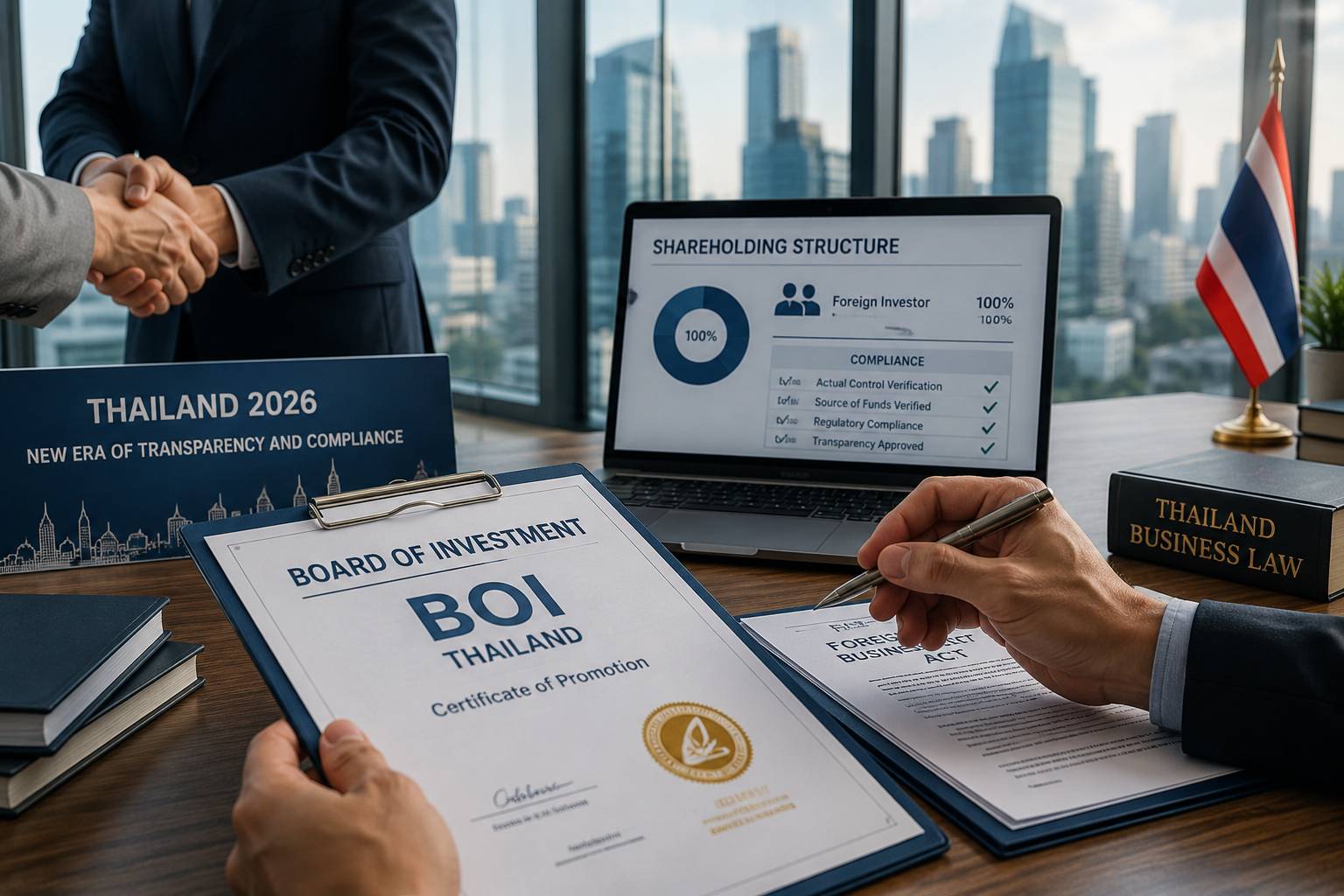
As the regulatory environment becomes stricter, BOI promotion is increasingly viewed as the most reliable and compliant solution for foreign investors seeking long-term business stability in Thailand.
Unlike traditional shareholding structures that may rely on Thai majority ownership, BOI-promoted companies can receive permission for up to 100% foreign ownership in eligible business sectors.
This allows foreign investors to maintain lawful ownership and operational control without relying on potentially vulnerable nominee arrangements.
In addition to ownership flexibility, BOI-promoted companies may also benefit from:
- corporate income tax incentives
- import duty exemptions
- land ownership rights for promoted activities
- streamlined visa and work permit procedures, and
- exemptions from certain Foreign Business Act restrictions.
Most importantly, BOI promotion provides a transparent and government-approved structure that significantly reduces the legal uncertainty associated with nominee shareholding models.
For many foreign investors, BOI promotion is no longer viewed simply as a tax incentive program. It is now increasingly regarded as a strategic compliance solution for operating securely in Thailand’s evolving regulatory environment.
What Foreign Investors Should Do Now
Foreign investors currently operating in Thailand should carefully reassess their company structures and compliance readiness under the new enforcement landscape.
Businesses using Thai-majority ownership arrangements should review whether their shareholders can genuinely support their investment positions with appropriate financial evidence and documentation.
Companies should also ensure that:
- shareholder funding records are properly maintained
- corporate governance documents are updated
- director authorities accurately reflect operational realities, and
- ownership structures remain legally defensible under stricter regulatory scrutiny.
For businesses planning long-term operations in Thailand, evaluating eligibility for BOI promotion may now be more important than ever.
Industries such as technology, software development, digital services, manufacturing, logistics, renewable energy, regional headquarters, and targeted innovation sectors may qualify for significant BOI privileges that provide both operational flexibility and stronger legal protection.
A New Era of Foreign Business Enforcement in Thailand
Thailand’s 2026 “Actual Control” crackdown reflects a broader transformation in how foreign business compliance is being enforced.
The authorities are no longer focused solely on who appears on the shareholder register. Instead, they are increasingly asking deeper questions:
Who funded the company? Who bears the financial risk? Who truly controls the business?
For foreign investors, the message is becoming increasingly clear. The era of relying on hidden nominee arrangements is rapidly fading, while transparent and properly authorized ownership structures are becoming essential for long-term business security.
In this changing regulatory landscape, BOI promotion has emerged as one of the most important tools for foreign businesses seeking stability, legal certainty, and sustainable growth in Thailand.
