


Thailand’s employment and immigration framework is undergoing one of its most significant technological transformations in decades. Beginning in 2026, the Ministry of Labor and related government agencies are intensifying digital identity verification requirements for both employers and foreign employees as part of the country’s broader national digital governance strategy.
The traditional work permit process — once centered primarily
on document submissions and manual approvals — is rapidly evolving into a highly secured digital ecosystem driven by biometric authentication, centralized identity databases, and government-backed electronic verification systems.
At the center of this transformation are two major compliance pillars: mandatory employer authentication through the ThaID application and compulsory biometric registration for foreign workers. Together, these measures reflect Thailand’s increasing emphasis on cybersecurity, fraud prevention, and transparent labor management within an increasingly globalized economy.
ThaID Authentication Becomes Mandatory for Employer Sponsorship

Under the updated digital labor administration framework, company directors and authorized HR representatives are now required to complete cryptographic identity verification through the official ThaID mobile application before accessing government portals related to foreign worker sponsorship.
This development represents far more than a simple login upgrade. ThaID functions as Thailand’s official digital identity infrastructure, enabling government agencies to verify the legitimacy of corporate representatives through encrypted identity authentication tied directly to national civil registration databases.
For businesses employing foreign talent, this means that sponsorship authority is no longer based solely on corporate documents or signed authorization letters. Instead, the government now requires real-time digital identity confirmation from the individual legally responsible for the submission.
From a compliance perspective, the implications are substantial. Companies must ensure that their directors, shareholders with signing authority, or designated HR personnel maintain active and properly verified ThaID accounts. Failure to complete the authentication process can effectively block access to labor and immigration systems, delaying work permit applications, visa extensions, and employee onboarding processes.
This change also aligns with Thailand’s broader digital government initiatives aimed at reducing nominee structures, preventing identity misuse, and strengthening accountability within foreign employment sponsorship procedures.
Mandatory Biometric Registration for Foreign Employees
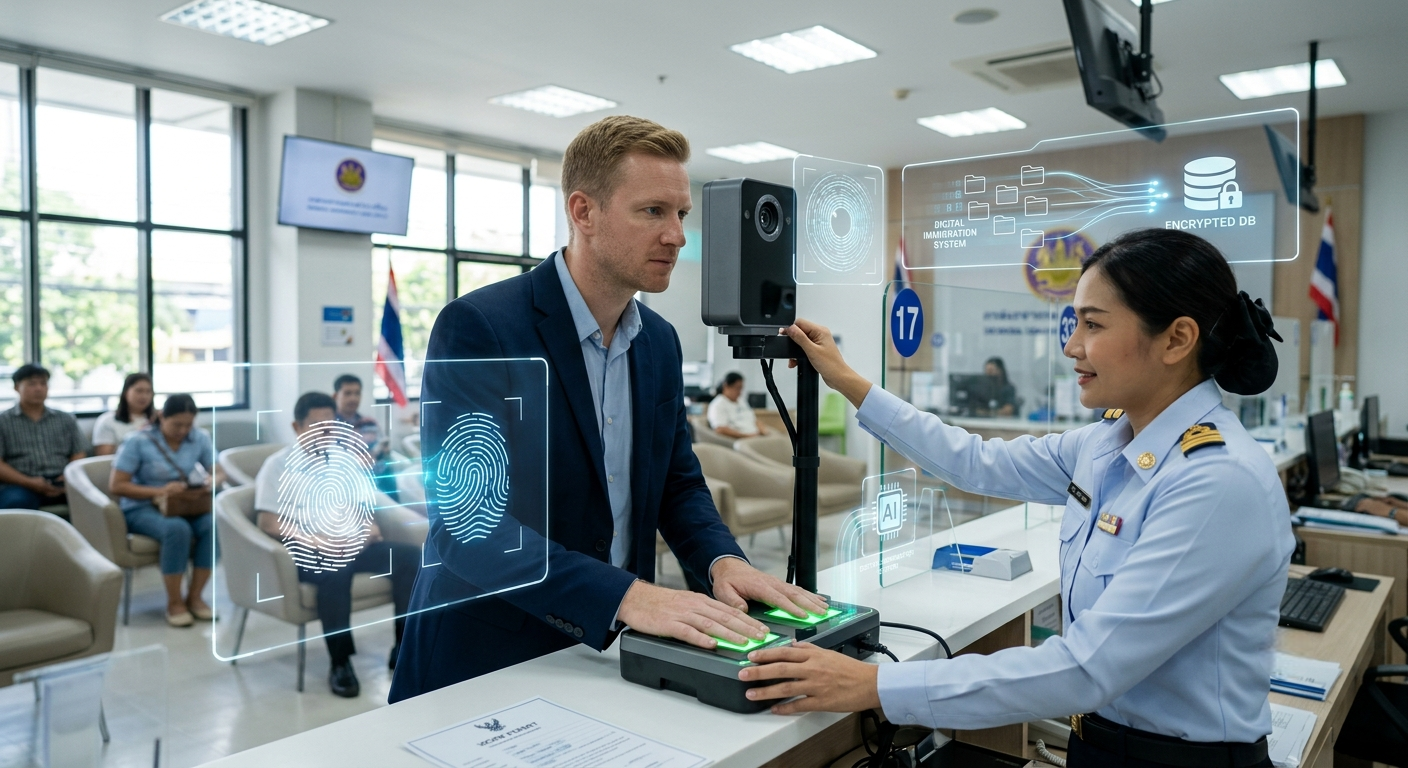
In parallel with employer verification reforms, foreign nationals applying for work authorization are now subject to enhanced biometric enrollment requirements at Provincial Labor Offices nationwide.
The updated process includes in-person identity validation through 10-fingerprint collection and high-definition iris scanning. These biometric records are integrated into centralized government databases shared across labor, immigration, and national security agencies.
Thai authorities view the system as a critical safeguard against identity fraud, duplicate registrations, unauthorized employment, and visa misuse. By linking biometric data directly to immigration and employment records, regulators can significantly strengthen monitoring capabilities while reducing administrative inconsistencies between agencies.
For foreign professionals and expatriate employees, the practical impact is clear: physical presence during the registration stage is now indispensable. Remote processing and representative-only submissions are becoming increasingly restricted as biometric verification becomes a mandatory compliance checkpoint.
Businesses should also anticipate tighter appointment scheduling procedures, stricter document consistency reviews, and longer preparation timelines for onboarding international employees.
Strategic Compliance Considerations for International Businesses
For multinational corporations, BOI-promoted entities, and foreign-invested businesses operating in Thailand, these reforms signal a broader transition toward integrated digital compliance management.
The modernization of Thailand’s labor administration is not occurring in isolation. It forms part of a larger national strategy involving digital visas, electronic work permits, integrated immigration databases, AI-assisted document screening, and cross-agency data synchronization.
As a result, companies can no longer treat work permit applications as routine administrative tasks handled at the final stage of recruitment. Instead, workforce mobility planning now requires proactive compliance coordination between legal, HR, IT security, and executive management teams.
Organizations employing foreign personnel should begin reviewing several operational areas immediately, including:
- Internal authorization structures for ThaID verification access
- Digital document management standards and cybersecurity controls
- Employee onboarding timelines incorporating biometric appointments
- Cross-border mobility policies and immigration compliance workflows
- Data privacy considerations related to biometric information handling
Businesses that adapt early will benefit from smoother processing, reduced regulatory risk, and stronger alignment with Thailand’s rapidly evolving digital governance environment.
Thailand’s Digital Labor Future Is Already Taking Shape
Thailand’s 2026 reforms demonstrate a clear policy direction: labor and immigration systems are becoming increasingly data-driven, interconnected, and security-focused.
The introduction of ThaID verification and mandatory biometric registration is not merely a procedural update — it reflects the government’s long-term vision for a fully digitized workforce administration ecosystem capable of supporting investment growth while strengthening regulatory oversight.
For employers, the message is unmistakable. Future compliance will depend not only on submitting accurate paperwork, but also on maintaining robust digital identity governance and operational readiness within an increasingly technology-centered regulatory environment.
As Thailand continues positioning itself as a regional investment and talent hub, businesses that understand and prepare for these digital compliance expectations will be significantly better positioned to navigate the next generation of workforce regulation.
