


Thailand’s investment promotion landscape is entering a significant transition as the OECD’s Pillar Two Global Minimum Tax (GMT) framework begins reshaping how multinational enterprises evaluate tax incentives worldwide.
For many years, the Board of Investment (BOI) positioned Thailand as a highly attractive regional investment hub through generous Corporate Income Tax (CIT) holidays, including incentives of up to 13 years for targeted industries. However, for multinational enterprise (MNE) groups with consolidated global revenues exceeding EUR 750 million, these traditional tax holidays are no longer as effective as they once were.
Under Pillar Two rules, if a Thai entity benefits from a 0% CIT incentive but its effective tax rate falls below the global minimum threshold of 15%, another jurisdiction within the group structure — typically the parent company’s country — may impose a “top-up tax” to bridge the gap. In practice, this means the tax advantage granted by Thailand may ultimately be collected elsewhere rather than retained within the group.
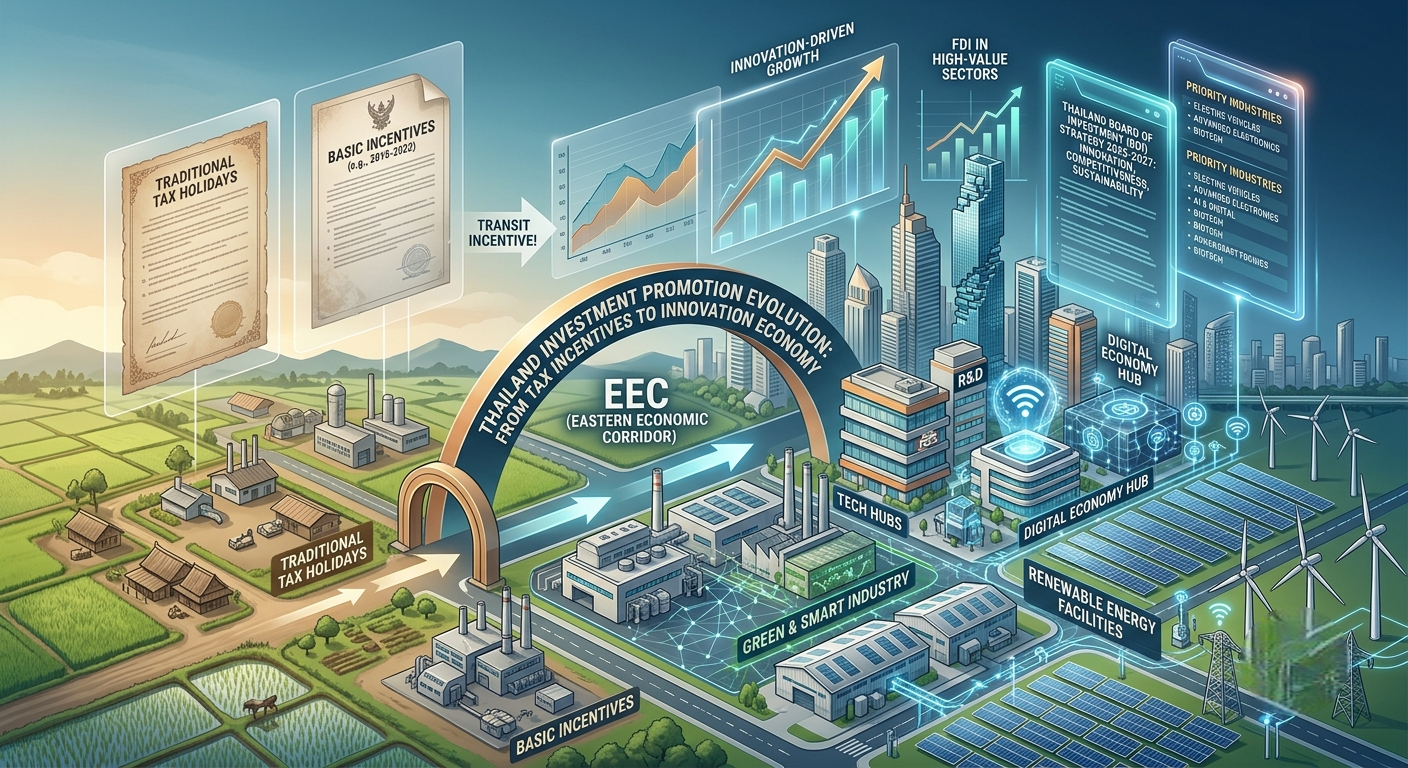
As a result, Thailand is increasingly redesigning its investment promotion strategy away from pure tax exemption models and toward substance-based incentives that remain commercially valuable under the new international tax environment.
The Transition Toward Refundable Tax Credits

To maintain competitiveness, Thailand’s BOI is gradually shifting its focus toward refundable tax credits and incentive structures linked to real economic activity. Rather than relying solely on extended tax holidays, the government is emphasizing “Qualifying Expenditures” that support long-term industrial development and technological advancement.
This policy direction aligns with broader international trends, where governments are encouraging companies to create measurable economic substance instead of merely locating profits in low-tax jurisdictions.
In Thailand, expenditures related to advanced workforce development, research and development (R&D), digital transformation, automation, and environmental sustainability are becoming increasingly important within BOI promotion frameworks. Investments in renewable energy systems, smart manufacturing infrastructure, and carbon reduction technologies are also receiving stronger policy attention as Thailand advances its carbon neutrality and ESG objectives.
For large multinational groups affected by Pillar Two, these refundable credit mechanisms may provide greater practical value than conventional CIT holidays because of how certain credits are treated under global minimum tax calculations.
AI, Innovation, and Green Technology as New Priority Areas
Thailand’s current BOI strategy demonstrates a clear policy intention: the country wants to attract high-value and innovation-driven investment rather than purely labor-intensive operations.
Artificial Intelligence (AI), advanced electronics, biotechnology, smart manufacturing, robotics, and clean energy projects are now among the sectors receiving enhanced strategic support. However, obtaining BOI incentives for these activities is becoming more technically demanding than in previous years.
Authorities increasingly assess whether companies can demonstrate genuine operational capability, meaningful technology deployment, and long-term commitment to Thailand’s economy. In many cases, the BOI review process now goes beyond financial projections and examines the actual technical substance of proposed operations.
This is especially visible in projects categorized under higher-tier incentive groups, where discussions surrounding innovation capacity, automation systems, technical workforce development, and sustainability commitments have become central parts of the approval process.
“Technology Transfer” Is Facing Greater Scrutiny
One of the most important developments in Thailand’s investment promotion policy is the growing scrutiny surrounding “technology transfer” claims.
In the past, many applications referenced technology transfer in relatively broad terms. Today, BOI authorities increasingly expect investors to demonstrate how technical expertise, innovation capability, and operational knowledge will genuinely be developed within Thailand.
This includes evaluating whether Thai employees receive advanced technical training, whether local teams participate in core engineering or R&D activities, and whether meaningful operational know-how is being localized rather than simply managed from overseas headquarters.
For AI and software-related businesses, the distinction between genuine innovation activity and simple regional service operations is becoming increasingly important. Authorities are focusing more closely on whether projects contribute to Thailand’s long-term capability development and industrial upgrading objectives.
This reflects Thailand’s broader economic ambition to evolve beyond its traditional manufacturing base and strengthen its position as a regional technology and innovation hub within ASEAN.
Strategic Implications for Multinational Enterprises
The emergence of Pillar Two is not simply a tax technicality; it fundamentally changes how multinational enterprises should approach investment structuring in Thailand.
Historically, investment planning often centered on maximizing the duration of tax holidays. Under the new environment, companies must instead consider how their Thai operations create measurable economic substance through innovation, skilled employment, sustainability initiatives, and operational value creation.
As Thailand adapts its BOI framework to the global minimum tax era, successful investors will likely be those capable of combining tax efficiency with genuine business substance. The future of investment promotion is moving away from purely low-tax models and toward incentive systems designed to reward innovation, advanced capability, and long-term economic contribution.
For multinational enterprises evaluating Thailand as a regional investment destination, the central question is no longer simply how many years of tax exemption can be obtained. Increasingly, the more important consideration is how effectively an investment can contribute to Thailand’s strategic economic transformation while remaining efficient within the evolving global tax landscape.
