


As Thailand continues strengthening tax enforcement and modernizing its revenue framework, two major developments are reshaping the landscape for businesses, expatriates, investors, and online consumers:
- VAT and import duty reform on cross-border e-commerce imports
- Revised taxation of foreign-sourced income remitted into Thailand
These changes reflect the government’s push toward transparency, fairness, and expanded tax compliance.
VAT on E-Commerce Imports – Removal of Low-Value Exemption
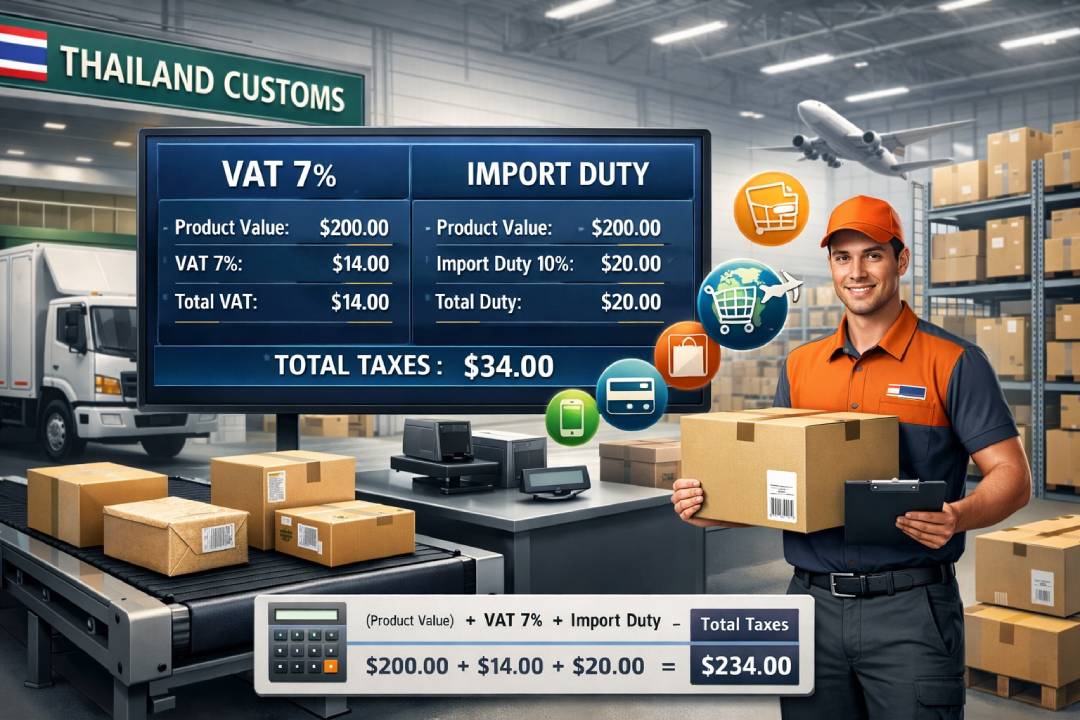
Thailand has revised its import tax framework to address growing cross-border online shopping and competitive imbalance between domestic and foreign sellers.
What Has Changed?
Previously, imported goods valued at not more than THB 1,500 were exempt from import duty and often experienced simplified VAT treatment.
Under new measures announced by the Thai Customs Department, effective 1 January 2026:
The THB 1,500 exemption threshold is abolished.
All imported goods — regardless of value — are subject to:
- 7% VAT
- Applicable import duty (depending on tariff classification)
How Will Tax Be Collected?
- Postal shipments: VAT and duty are assessed at customs; recipients must pay before collection.
- Courier shipments: Courier operators may prepay duties and VAT and collect from recipients upon delivery.
- Online platforms: Some platforms may integrate tax collection at checkout under customs arrangements.
Business Implications
- Increased compliance requirements for importers
- Higher landed costs for cross-border online purchases
- Fairer competition for Thai SMEs subject to VAT obligations
- Potential impact on pricing strategies for e-commerce operators
Companies engaged in drop-shipping, cross-border retail, or marketplace sales should immediately reassess supply chain structures and tax calculations.
Foreign Income Remittance – A Major Shift in Thai Personal Taxation
Thailand significantly changed the taxation of foreign-sourced income beginning 1 January 2024.
Under guidance from the Thai Revenue Department, Thai tax residents (individuals staying in Thailand ≥ 180 days in a calendar year) are now taxed on foreign income when it is remitted into Thailand — regardless of when the income was earned.
Previous Rule (Before 2024)
Foreign income was taxable only if:
- It was earned and
- Remitted into Thailand within the same tax year.
Current Rule (From 2024 Onward)
Foreign income becomes taxable when remitted into Thailand — even if earned in a prior year.
This change significantly affects:
- Remote workers and digital nomads
- Foreign investors
- Shareholders receiving overseas dividends
- Individuals holding foreign bank accounts
- Thai residents with offshore assets
Income not remitted into Thailand remains outside Thai tax scope under the current framework.
Proposed Relief: Two-Year Remittance Window (Under Review)
There is ongoing discussion regarding a potential amendment that would allow a grace period:
- Foreign income remitted within the same year or the following year may be exempt from Thai tax.
- Remittances after that period may remain taxable.
However, this proposal is still under review and has not yet been enacted into law.
Businesses and individuals should not rely on draft proposals until they are officially announced.
Strategic Considerations for Businesses & Individuals
For Businesses
- Review VAT registration and customs compliance for cross-border sales.
- Recalculate landed cost projections for imported goods.
- Adjust pricing models and supplier contracts.
- Ensure payroll and executive compensation structures consider foreign income exposure.
For Individuals & Executives
- Assess Thai tax residency status annually.
- Review timing of foreign income remittances.
- Maintain documentation evidencing source and year of income.
- Evaluate the applicability of double tax treaties where relevant.
Thailand is clearly moving toward:
- Enhanced digital tax monitoring
- Reduced loopholes in cross-border taxation
- Stronger revenue enforcement mechanisms
For accounting and legal professionals, these developments require proactive advisory support rather than reactive compliance.
