


As global supply chains shift and ASEAN continues to rise as an economic powerhouse, Thailand is emerging in 2026 as one of Southeast Asia’s most strategic investment destinations.
With strong infrastructure, investor-friendly policies, and a mature regulatory framework, Thailand is no longer just a manufacturing base — it is becoming a regional headquarters hub, innovation center, and gateway to ASEAN.
Strategic Location at the Heart of ASEAN
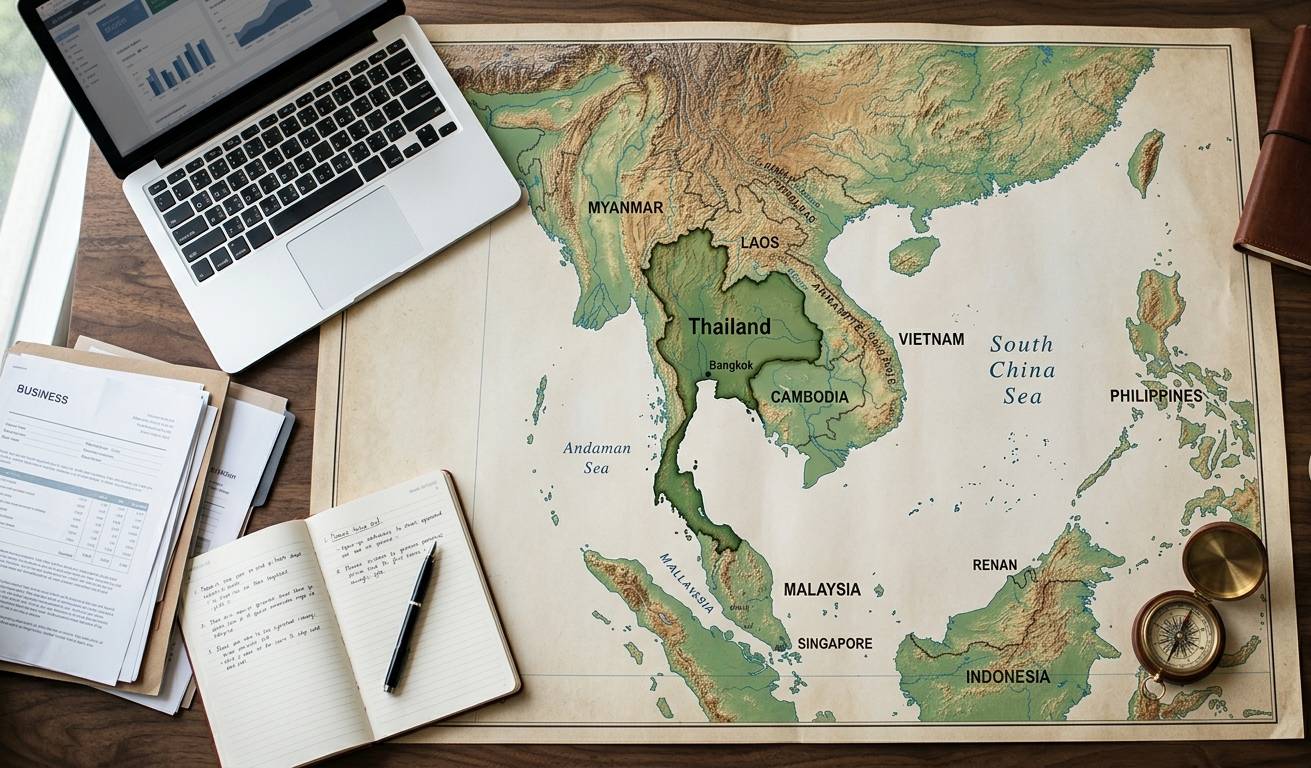
Located centrally within Southeast Asia, Thailand provides direct access to a combined market of over 660 million people. Its geographic position supports trade connectivity with China, India, and the broader Asia-Pacific region.
Major infrastructure initiatives — including the Eastern Economic Corridor (EEC) — continue to strengthen Thailand’s logistics, aviation, and high-tech industrial capabilities.
Strong Government Support for Foreign Investors
Thailand actively promotes foreign direct investment through the Board of Investment (BOI), offering incentives such as:
- Corporate income tax exemptions (up to 8–13 years for promoted sectors)
- Import duty exemptions on machinery and raw materials
- 100% foreign ownership in certain industries
- Visa and work permit facilitation
The government continues to prioritize future industries, including EV manufacturing, digital technology, smart electronics, biotechnology, and renewable energy.
Developed Legal & Regulatory Framework
Thailand maintains a structured regulatory system supported by key authorities including:
- Department of Business Development – Company registration and corporate governance oversight
- Revenue Department – Tax compliance and administration
- Securities and Exchange Commission – Capital market regulation
Recent regulatory updates reflect stronger corporate governance standards, transparency requirements, and digital filing systems — increasing investor confidence while ensuring compliance discipline.
Competitive Cost Structure with Skilled Workforce
Compared to several regional peers, Thailand offers:
- Competitive labor costs
- Skilled technical and engineering workforce
- Advanced manufacturing ecosystem
- Established automotive and electronics supply chains
Thailand remains one of the world’s largest automotive production hubs and is accelerating toward becoming a regional EV production center.
Growing Digital & Innovation Ecosystem
Thailand’s digital economy continues to expand rapidly. Government initiatives support:
- FinTech
- E-commerce
- Data centers
- AI and smart manufacturing
The country’s digital infrastructure and regulatory framework are evolving to attract tech investors and regional headquarters operations.
Political Stability & Economic Resilience
While global markets face uncertainty, Thailand demonstrates economic resilience supported by:
- Diversified exports
- Strong tourism recovery
- Stable banking system
- Controlled inflation environment
For investors seeking both growth and stability within ASEAN, Thailand offers a balanced risk-return profile.
Why 2026 Is a Pivotal Year
Global companies are restructuring supply chains, implementing “China+1” strategies, and diversifying manufacturing and regional operations. Thailand is a primary beneficiary of this shift.
The combination of:
- Infrastructure expansion
- Pro-investment policies
- Regulatory modernization
- Regional connectivity
positions Thailand as a leading investment hub in Southeast Asia for 2026 and beyond.
Thailand is not simply competing on cost — it is competing on ecosystem strength, governance standards, and long-term strategic positioning.
For businesses considering regional expansion, market entry, or restructuring in ASEAN, Thailand deserves serious strategic attention in 2026.
The opportunity is significant — but success requires proper structuring, regulatory alignment, and proactive compliance planning.
